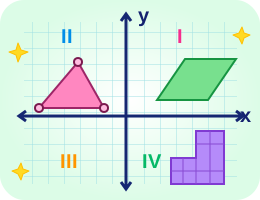
Plane Figures and Coordinate Geometry
Learn with worked examples, then try the questions below.
1Area of a triangle
A triangle is half a parallelogram with the same base and perpendicular height. Height is measured at a right angle to the base.
Do not use a sloping side as the height unless it is perpendicular to the base.
2Parallelograms and composite shapes
For a parallelogram, multiply base by perpendicular height. Split a composite shape into simple shapes, then add or subtract their areas.
A 10 × 8 rectangle with a 4 × 3 corner removed has area 80 − 12 = 68 cm².
3Plot polygons in four quadrants
Plot each ordered pair (x, y), connect the vertices in order, and close the shape. Right and up are positive; left and down are negative.
The four vertices lie in quadrants II, I, IV, and III respectively. Its horizontal sides have matching y-coordinates.
4Use coordinates to find area
Find horizontal and vertical distances by subtracting coordinates. Distances are positive, even when coordinates are negative.
The rectangle has area 7 × 4 = 28 square units. Reflecting a point across the x-axis changes only the sign of y.
⭐ Try it yourself!
Question 1 of 5
A triangle has base 12 cm and perpendicular height 5 cm. What is its area?
Need a hint?
Use half the product of base and height.